Wednesday, September 10, 2014

When Art + Writing Works

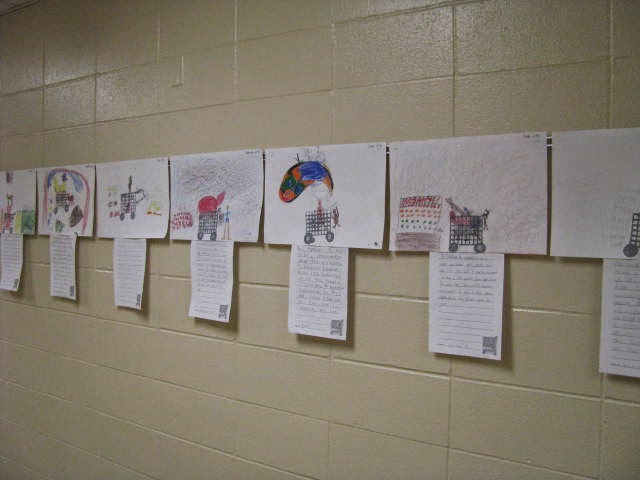
Update on my To Market To Market lesson: here are some of the cutie-patootie writings from my second graders (with the illustrations)

Illustration (writing is attached under)

Close up of the writing for your reading pleasure.

I really love how the classroom teacher added a clip-art shopping cart at the bottom of their writing paper.  She is a good friend of mine and knows I can be a bit, ummm, should we say severe about wanting my displayed student work to be amazing.  All the time. Every time.

Here's a few more:

Illustration for the writing below.


Illustration for the writing below.

The first class I had do this has writing that not as descriptive.  I really blame myself for not being clear with the classroom teacher, not re-reading the book to the students so it would be fresh in their minds, and being overly excited when she gave them to me the day after our illustrations were complete--thorough work is better than quick work in my opinion.
All in all, I'm happy with our collaborative results!


Tuesday, September 9, 2014

I Don't Have a Catchy Title For This

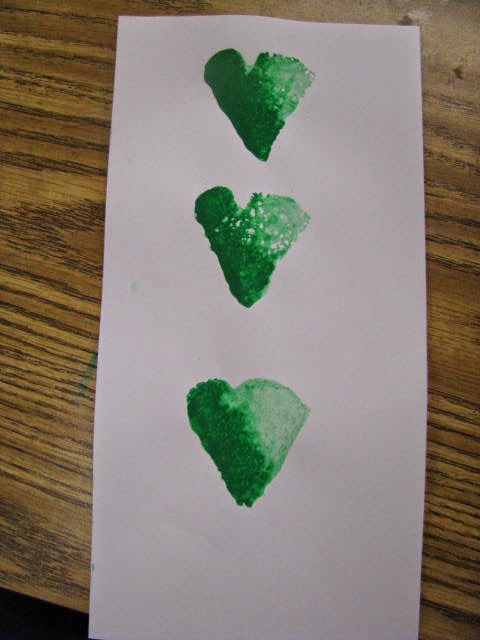
Maybe it's for lack of trying??? I don't really know, but this is a lesson I did hundreds of years ago (perhaps I exaggerate just a smidge).  I think I called it "Shape Patterns" or something like that, but I never remembered what it was and I'd have to look at that little picture I draw on all my lesson plans to remember what it was.  Now that I've really sold this lesson to you as totally stellar, here it is:


And a whole-display shot:


I've done a lot of questioning about lessons lately.  As in--"is this lesson worth it? Is it worth my time? The students time?  Is it meeting real learning objectives?" etc.  Because it had been so long since I'd done this lesson, I pulled it back out to do and check/think about those things.  I decided I do like this lesson and it's a keeper (though maybe not something I'd do every single year) for these reasons: it's pretty successful for everyone.  It has a twist that makes it something the students remember for several years, AND I can change it up (like, this year we talked about warm and cool colors, but we could do primary/secondary, complementary/analogous. . . )  With all of that, here's what we did:
We talked about shape.  I had the students raise their hands and name some shapes.  Then I showed them how to draw a shape inside a rectangle on the board, in such a way that it touches every side (because I don't want those itty-bitty middle of the paper shapes).  Then I gave each student a thick piece of paper that was really compressed sponge (you can order it from supply catalogs, or from here, here or here) and had them draw their shape on it with pencil.  It's hard work to cut them out, but they're so strong that they can manage.  Now the magic happens, people!  They throw away their trash, I give each table a small cup of water, and they put their shape in there! Oh, it's amazing, I tell you! The screams of delight that fill the room!


Like magic, it becomes a SPONGE!
Then we squeeze the extra water out and print with them on 6" x 12" paper:


Now the messy part: having 20+ first graders washing paint out of their sponge so they can take it home to keep forever and ever (I tell them it's a great bathtub toy, it makes lots of bubbles with your soap!) I have extra paper for drawing/coloring while they're waiting their cleaning turn.
The next time, I talked with them about warm and cool colors and had them pick warm or cool crayons and color around their shapes:


 We also talked about power coloring and using our art muscles to get a nice, thick layer of color on there (some did better than others with this).  
The final step was to use puff paint to outline our shapes:


My final review of this lesson is it was good for fine-motor control (the puff paint/outlining their shape) as well as shape review and learning about color.  I hope they're having some fun with their sponges at home, too.

Thursday, September 4, 2014

Second Grade Goes To Market To Market

As I alluded to in a previous post, I planned on using the book To Market To Market by Anne Miranda with my second graders this year.  We're finishing up our projects now, and I'm getting happier with them.  Ever notice how sometimes it's takes a time or two to figure out how to get the best work out of students?  That was me with this lesson.  It could have something to do with trying to get back in the groove of school, or it just could have been trying to figure out the best way to present the lesson since it was the first time, who knows?  But my second class' drawings were so much more colorful and detailed than my first class:


Here's the how-we-did-it:  I read the book, and they're second graders, so they HOWLED with laughter at the funny parts and the funny pictures.  We all loved the askew glasses and the 'THIS IS THE LAST STRAW!' part.  Then they went back to their tables with a piece of 12 x 18 white paper and a paint shirt.  I demonstrated using the bottom of a strawberry basket (the plastic green kind: I ordered a set off Ebay for next to nothing) to print the cart, and then used lids off soda bottles to print the wheels.  We didn't have any gray paint, so we mixed black and white with craft sticks in our paint pallets (also known as ice cream bucket lids, the round plastic kind, I use them for just about everything).  We then used those same craft sticks to print a little cart handle:


When they were done with their printing, they gave their paper to me to go in the drying rack and went back to their seats to make lists and drawings in their sketchbooks of what animals they'd put in their shopping carts:


I encouraged them to use descriptive words to describe their animals.

Though some were more descriptive than others. . . 


The next time that they came to class, they drew their animals in their carts.  I knew I'd get a lot of stiff-looking animals, so I demonstrated squeezing elephants and whales into carts in my drawings on the board.  This really helped them to think about how an elephant or lion or bear would look in a shopping cart.  The next time they came I let them color them with color sticks (the colored pencil without the wood things).


Now I'm sending the drawings back to their classrooms so they can write their own To Market To Market story.  I'm asking the classroom teachers to attach their writing and then send them back to me to display.  Hoping for cuteness + inspired writing here, so keep your fingers crossed, and I'll let you know.
One more for the road:


Wednesday, September 3, 2014

I Just LOVE

--deep conversations about educational theory.  And no, I'm not being sarcastic or cynical.  I truly love it.  My day started out with an all-staff meeting/professional development/collaboration time centered around our new teacher evaluation system.  NEE was developed by some university people and is changing the way teachers in my state are evaluated (now on a seven point scale).  Today was just the beginning of our conversation and deeper understanding of the new system, and we read articles and discussed cognitive engagement.  I could really talk about it all day.  This is when I really miss being new to education and being surrounded by other new-to-education peers.  It seems like when you're mid-career and surrounded by the same, people are more focused on retirement than philosophical discussion, and that's just too bad.
Sooooo, anytime you're wanting to discuss some educational theory, feel free to email me or write a comment on my blog, I'd love to converse with you!!!

Monday, September 1, 2014

Let's Talk About Expectations

When you've taught a while (15 years) in the same building (8 years) sometimes it's easy to get a little lax with explaining your expectations.  'So many of the students know me' you (I) think and 'it's not really necessary' and 'everything's going so well.' And then you're thrown into a different situation (covering someone else's class, traveling to a different building, whatever) and you skip over the unnecessary step of thoroughly explaining what expectations you have.  This, friends, is where the students hand you your experience card with a little smile and a wink.  It means nothing, because you have forgotten a vital fact: they're kids.  They're at school, doing kid things, having kid thoughts. Daydreaming, thinking about recess or lunch or how tight their new shoes are, and they'll do what they've always done.  If art class has always = chaos, a different adult it the room isn't going to change that.  They are living the only reality they've ever known.  This is where I sometimes lose my mind.  I drove away from a morning where things slid the slippery slope down to mayhem so quickly, and I thought of all the times I've heard another teacher say "oh, I don't paint/use clay/cut with them, they can't handle it." Seven and half years in an urban elementary school taught me lots every single day, and the biggest lesson was this: it's all about your expectations, and how carefully you lay them out for the students.  Sure, it's more work for the adult, and not work I'm particularly good at (see aforementioned mayhem morning) but so worth it in the end to clearly lay out your expectations.  And we all know about difficult classes, ones that seem to thrive on the chaos and drama, but you know what? They deserve the good stuff too. This is the only time they'll be in second grade or fourth grade or fifth grade and I want art to be the thing they remember fondly.  I don't want to be remembered as the angry, cranky art teacher that the students say "why did she become a teacher anyway???"  Most of the time (probably not all of the time) they're just being kids, they're not trying to rile you up or make you quit or anything so sinister.  They're wandering the room, talking into the fan to hear the robot voice, messing around with their friends, because this was all that was expected of them before.  This is just clarification for you (or me) as the adult in charge that you need to slow it down and lay it all out for them.  And probably over and over and over.  Because they deserve the best you, the best art experience and the best education you can give them.
So the next time I see my students who slid so quickly to chaos, I'll be explaining the expectations to them.  And the time after that and the time after that and the time after that.  

Wednesday, August 13, 2014

Back at It!

Is it me, or does the summer go faster every year?  I thought 'wow, so much time, this is going to be awesome' in June, and here we are, back at school already!  While I've been focused on my own family and home all summer, I have been busy planning (mostly in my own head).  I've also Gelli-printed my buns off this summer.  So very addictive!  My PTA ordered me five Gelli plates at the end of the year, so I took one home to play with.  If you aren't familiar with them, click here.  Amazing, wonderful, with endless possibilities! In thinking through the procedure for using five Gelli plates with a class of 30 (these are the things you think of when you've taught 15 years), I came across this:


So now I want to team teach a science lesson with the sixth grade teachers where students are making their own gelli plates.  I tried it this summer and the alcohol did make mine mold, so I'd do the glycerin/gelatin route with students.  I'll let you know how it turns out.

I also found this book:

And it's every bit as good as it looks!  I'm developing a second grade lesson for this (also a printmaking lesson).  Apparently it's going to be a printmaking sort of year!!! On that note, let's all remember what sort of cuteness we get to be a part of every single day:


And I love them.  I really do.  I'm so very lucky to go to a job that's so fulfilling every day.  The big challenge is to remember that in February and March.

Monday, June 30, 2014

Clay Fish, Made Just in Time

I've been so busy enjoying my summer that I've been a neglectful blogger.  I wanted to write about this last-minute clay project that I snuck in just under the end-of-the-school-year wire.  Of course, I got the idea at a conference as I do so many. It was a total success!


The basic idea is that students use detailed drawings or images of fish to make their own out of clay.  I had a bunch of diagrammed black line fish drawings I used to use with second grade for an analogous fish project (I really should do that one again!) that my third graders used.  I demonstrated making a basic pinch pot, putting 1-2 crumpled paper towels inside and then pinching it to form the fish.  Easy-peezy and so successful for the end of the year!

A fish ready for firing.

A whole school of fish in my kiln!
Freshly fired fish.
In the above photo, you can see where one fin broke off.  There was very minimal breakage (that might have been the only thing), only happening when they pinched fins too thin.
We then painted our fish with cake temperas, using as much color as we wanted:


This was a great way to use up some of the last of some cake temperas I was planning on throwing out at the close of school (they get so mixed and GROSS). One class did try mixing some glitter medium into their paint, but none of us felt it was worth the hassle and you really had to strain to see any glitter.

Final step was a coat of gloss medium.


I do love how this project turned out, and I'd probably do it again, I just wouldn't wait until the last two weeks of school!
Pin It